Mortgage Calculator: How to Calculate Your Monthly Mortgage Payment
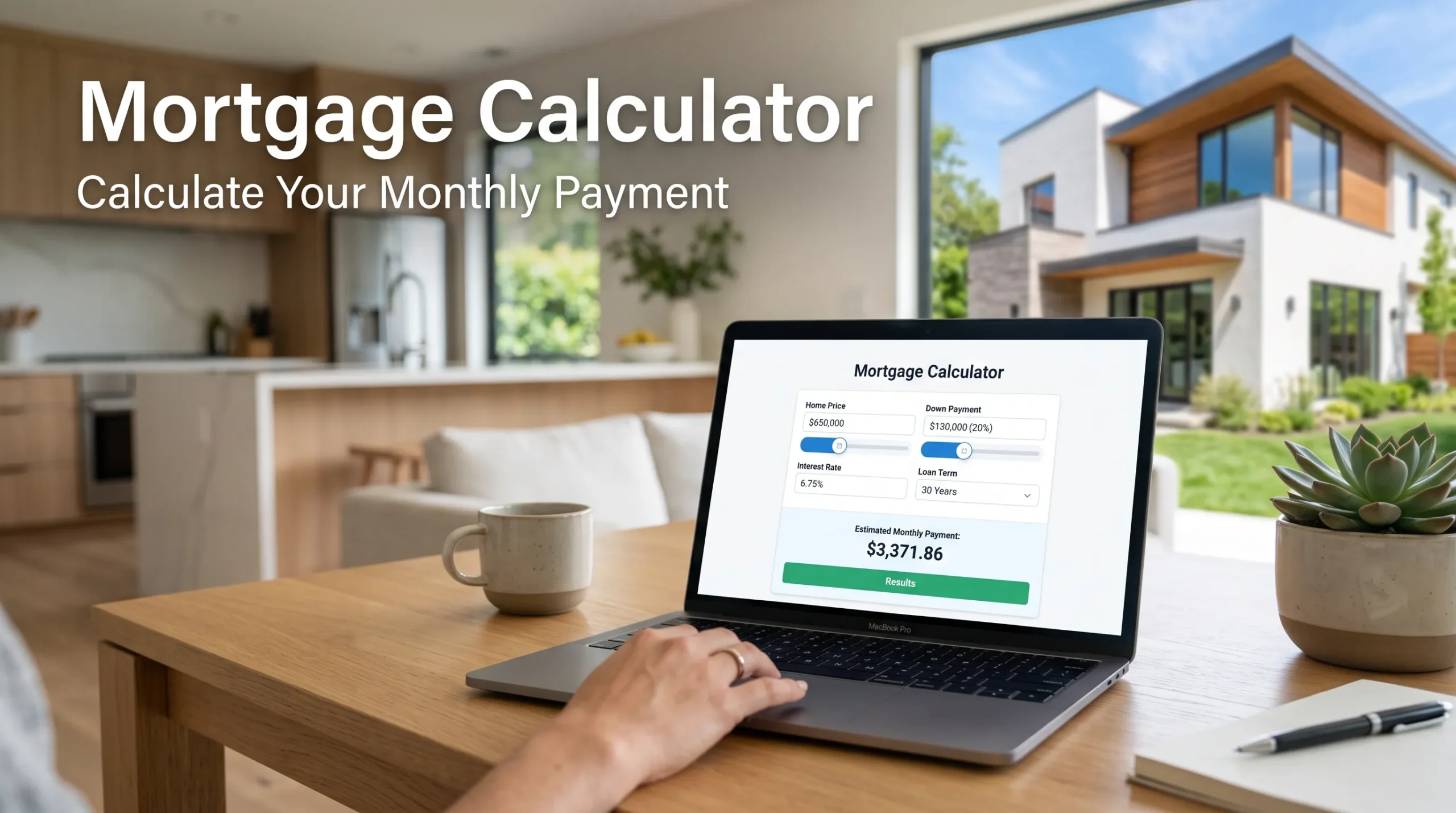
Buying a home is one of the biggest financial decisions most people will ever make, and the monthly payment is usually the number that matters most. A mortgage calculator lets you estimate that payment in seconds, before you ever sit down with a lender. Instead of guessing what a $300,000 or $500,000 home might cost you each month, you can plug in a few numbers and get a realistic picture of what to expect.
In this guide, we’ll walk through exactly how a mortgage calculator works, how the underlying math is calculated, what factors change your payment, and how to use these tools to plan a home purchase with confidence.
Table of Contents
What Is a Mortgage Calculator?
A mortgage calculator is a tool that estimates your monthly mortgage payment based on details like home price, down payment, interest rate, and loan term. Some people search for it as a “mtg calculator” or a “home loan calculator mortgage calculator,” but they’re all referring to the same basic concept: a quick way to estimate what a home loan will actually cost per month.
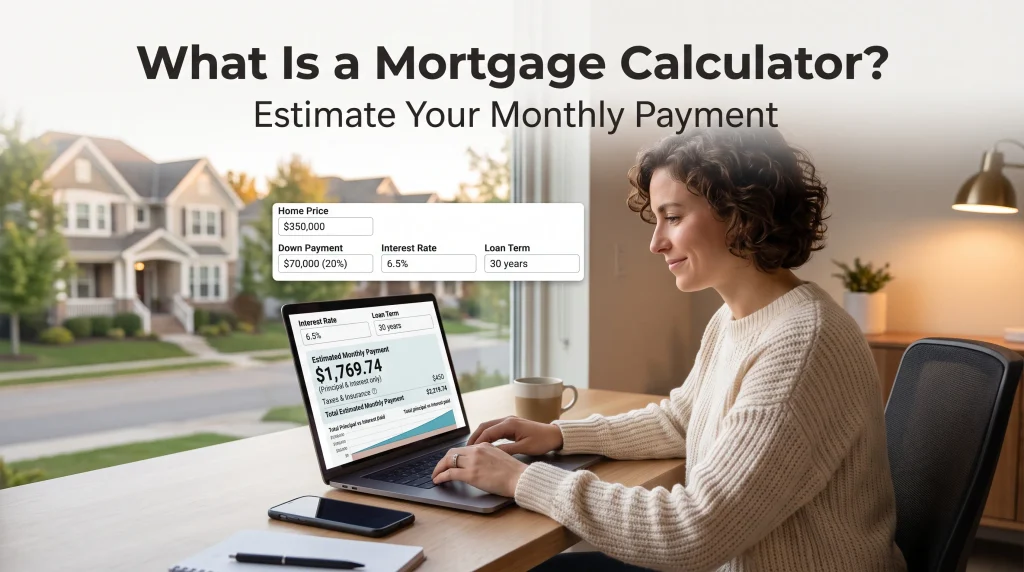
To generate an estimate, a mortgage calculator typically needs:
- The home’s purchase price
- Your planned down payment
- The interest rate you expect to qualify for
- The loan term (commonly 15 or 30 years)
- Optional extras like property taxes, homeowners insurance, PMI, and HOA fees
From there, the calculator applies a standard amortization formula to estimate your monthly principal and interest, then adds any other costs you’ve included to give you a fuller monthly total.
It’s important to understand that a mortgage calculator produces an estimate, not a guaranteed quote. Actual mortgage rates, taxes, insurance premiums, and lender fees vary based on your credit profile, location, loan type, and the lender you choose. For a binding number, you’ll need a formal loan estimate from a licensed lender.
Free Financial Tools
Use these free tools to plan your budget, mortgage, expenses, and savings goals.
Online Mortgage Calculator
Estimate your monthly mortgage payment and explore different loan scenarios.
Calculate MortgageMonthly Budget Calculator
Create a monthly budget and see how much you can allocate to your expenses.
Plan Your BudgetFree Expense Tracking
Track your spending and understand where your money goes each month.
Track ExpensesSavings Goal Calculator
Calculate how much you need to save each month to reach your savings goal.
Set Savings GoalHow to Calculate a Monthly Mortgage Payment
Calculating a mortgage payment by hand sounds intimidating, but the concept is fairly simple once you break it into parts.
The Building Blocks
- Home price — the purchase price of the property
- Down payment — the portion of the price you pay upfront, reducing your loan amount
- Loan amount — home price minus down payment; this is what you actually borrow
- Interest rate — the annual rate your lender charges, expressed as a percentage
- Loan term — how long you have to repay the loan, usually 15 or 30 years
- Property taxes — assessed by your local government, often collected monthly through an escrow account
- Homeowners insurance — protects the home and is usually required by the lender
- PMI (private mortgage insurance) — typically required when your down payment is less than 20%
- HOA fees — apply if the property is part of a homeowners association
A Simple Example
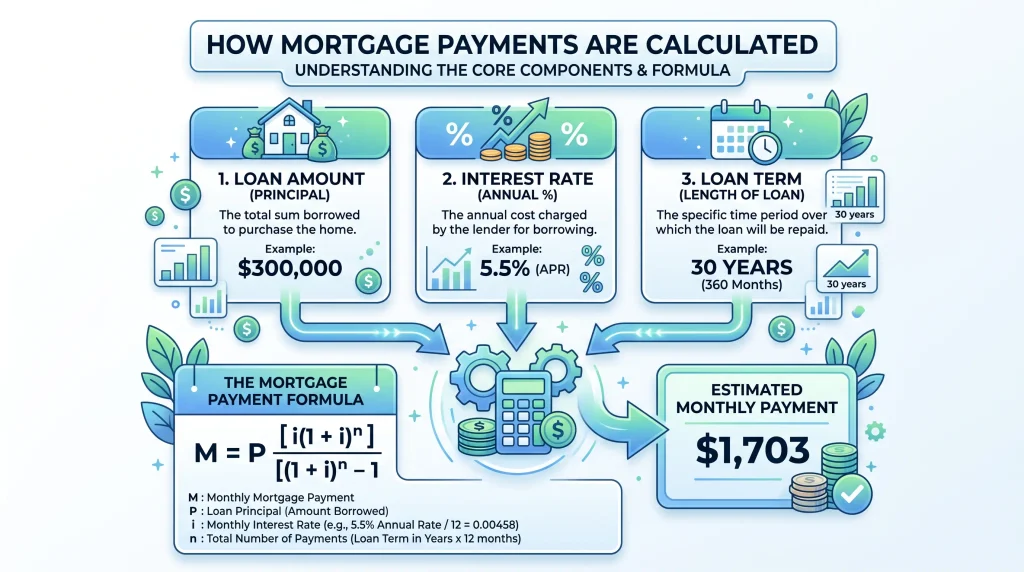
Say you’re buying a $300,000 home with a 20% down payment ($60,000). Your loan amount is $240,000. At a 6.5% interest rate on a 30-year term, your estimated principal and interest payment would be roughly $1,517 per month. Add estimated property taxes, homeowners insurance, and any HOA fees, and your total monthly housing cost would land somewhere above that base number.
Mortgage Payment Formula
The standard formula lenders use to calculate the principal and interest portion of a fixed-rate mortgage is:
M = P [ r(1+r)^n ] / [ (1+r)^n – 1 ]
- M = monthly payment
- P = loan principal (the amount borrowed)
- r = monthly interest rate (annual rate divided by 12)
- n = total number of payments (loan term in years × 12)
You don’t need to memorize this formula to use a mortgage calculator, but understanding it helps explain why even small changes in rate or term can shift your payment significantly. Using the earlier example — a $240,000 loan at 6.5% over 30 years — the monthly rate would be 0.065 ÷ 12, and the number of payments would be 30 × 12 = 360. Plugging those into the formula produces the same estimated payment of roughly $1,517.
How to Use an Online Mortgage Payment Calculator
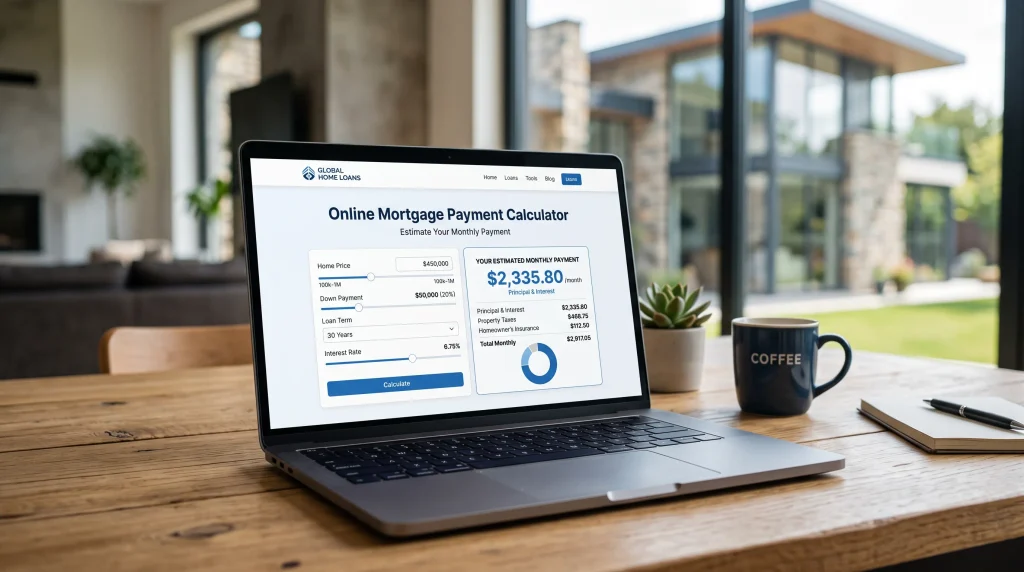
Most calculators follow a similar step-by-step flow:
- Enter the home price — the total purchase price you’re considering.
- Enter your down payment — either a dollar amount or a percentage of the home price.
- Enter the interest rate — use a current estimate or a rate quoted by a lender.
- Choose your loan term — commonly 15, 20, or 30 years.
- Add estimated property taxes — often available from your county assessor’s website.
- Add homeowners insurance — get a rough quote or use a local average.
- Include PMI if applicable — generally required for down payments under 20%.
- Include HOA fees if applicable — check with the property listing or association.
Once entered, the calculator instantly updates your estimated monthly payment. Adjusting any single variable — a larger down payment, a shorter term, or a lower rate — will change the result, which makes calculators useful for comparing different “what if” scenarios before you commit to an offer.
Ready to run your own numbers? Try the online mortgage calculator to see how different home prices and rates affect your monthly budget.
Mortgage Calculator vs. MTG Calculator
If you’ve searched for “mtg calculator” and landed here, you’re in the right place. “MTG” is simply a common shorthand abbreviation for “mortgage,” so an mtg calculator and a mortgage calculator refer to the exact same tool. Whether it’s labeled one way or the other, the goal is identical: estimating what your monthly home loan payment will look like based on price, rate, term, and other housing costs.
Home Loan Calculator Mortgage Calculator
A home loan calculator mortgage calculator is particularly useful when you’re comparing multiple loan scenarios rather than a single number. For example, you might want to see how a 30-year loan compares to a 15-year loan, or how your payment changes if you put down 10% instead of 20%. Running several scenarios side by side gives prospective buyers a clearer sense of affordability before they start house hunting or begin the pre-approval process with a lender.
What Is Included in a Monthly Mortgage Payment?
A full mortgage payment is often more than just principal and interest. Many homeowners refer to this combined payment using the acronym PITI.
| Component | What It Covers |
|---|---|
| Principal | The portion of your payment that reduces your loan balance |
| Interest | The cost charged by the lender for borrowing the money |
| Property Taxes | Local taxes based on your home’s assessed value, often escrowed monthly |
| Homeowners Insurance | Protects the home against damage; usually required by the lender |
| PMI | Private mortgage insurance, typically required with less than 20% down |
| HOA Fees | Fees paid to a homeowners association, if applicable |
Factors That Affect Your Mortgage Payment
Several variables influence how much you’ll pay each month:
- Home price — a higher price generally means a higher loan amount and payment
- Down payment — a larger down payment reduces the loan amount and may eliminate PMI
- Interest rate — even a small rate difference can meaningfully change your payment over a 30-year term
- Loan term — shorter terms mean higher monthly payments but less interest paid overall
- Credit profile — a stronger credit history often qualifies borrowers for more favorable rates
- Property taxes — vary significantly by city, county, and state
- Insurance costs — influenced by location, home age, and coverage level
- PMI — adds a recurring cost until you reach sufficient home equity
- HOA fees — vary by community and amenities offered
15-Year vs. 30-Year Mortgage
Loan term is one of the biggest levers affecting both your monthly payment and your long-term interest costs.
| Factor | 15-Year Mortgage | 30-Year Mortgage |
|---|---|---|
| Monthly Payment | Higher | Lower |
| Total Interest Paid | Lower | Higher |
| Payoff Timeline | Faster equity buildup | Longer repayment period |
| Monthly Flexibility | Less room in the budget | More room in the budget |
A 15-year mortgage typically carries a higher monthly payment but builds equity faster and results in significantly less interest paid over the life of the loan. A 30-year mortgage spreads payments out, resulting in a lower monthly obligation but more total interest over time. Neither option is inherently better — the right choice depends on your monthly budget, financial goals, and how much flexibility you want in your cash flow.
How Much House Can I Afford?
Housing affordability depends on more than just what a lender is willing to approve. It’s worth evaluating your full financial picture, including:
- Your monthly income and how stable it is
- Existing debts, such as car loans, student loans, or credit cards
- The size of your down payment
- The interest rate you expect to qualify for
- Property taxes and insurance in your target area
- Emergency savings you want to maintain
- Other regular monthly expenses, like childcare, utilities, or transportation
It’s worth noting that lender qualification and personal affordability aren’t always the same thing. A lender may approve you for a larger loan than you’d actually feel comfortable paying each month once you account for savings goals, other expenses, and financial cushion. Reviewing your full monthly budget — not just the loan approval amount — gives a more realistic picture of what you can afford. A monthly budget calculator can help you see how a potential mortgage payment fits alongside your other expenses.
Ways to Lower Your Monthly Mortgage Payment
If your estimated payment feels higher than you’d like, there are several factual strategies worth considering:
- Increase your down payment — reduces the loan amount and may help you avoid PMI
- Compare rates from multiple lenders — even a small rate difference affects your payment
- Choose a loan term that fits your budget — a longer term generally lowers the monthly payment
- Review unnecessary fees — ask lenders to explain each line item on a loan estimate
- Shop homeowners insurance — premiums can vary between insurers for similar coverage
- Understand when PMI applies — reaching 20% equity can eventually remove this cost
These strategies can help reduce costs, but actual savings depend on your credit profile, lender, location, and loan type — there’s no guaranteed outcome for every borrower.
Example Mortgage Calculation
Here’s a full illustrative example using realistic numbers:
- Home price: $300,000
- Down payment: $60,000 (20%)
- Loan amount: $240,000
- Interest rate: 6.5%
- Loan term: 30 years
Based on these inputs, the estimated principal and interest payment is approximately $1,517 per month. Adding estimated property taxes, homeowners insurance, and any HOA fees would increase the total monthly housing cost above this base figure. This example is illustrative only — actual mortgage rates, property taxes, insurance premiums, and fees vary by lender, location, and individual borrower circumstances.
Use Our Mortgage Calculator
Rather than doing this math by hand, you can get an instant estimate using the mortgage payment calculator. Simply enter your home price, down payment, interest rate, and loan term to see your estimated monthly payment, then adjust the numbers to compare different scenarios before you start house hunting.
Related Free Budgeting Tools
Calculating your mortgage payment is just one piece of planning a home purchase. Once you know your estimated payment, it helps to see how it fits into your broader financial picture. A monthly budget calculator can show you how a mortgage payment compares to your income and other monthly obligations.
It also helps to track where your money is currently going before you take on a new housing payment. A free expense tracking tool can highlight spending patterns and identify room in your budget for a future mortgage payment.
And if you’re still saving for your down payment, a savings goal calculator can help you map out a timeline for reaching your target down payment amount.
External Resources
For additional guidance on mortgages and home buying, these authoritative resources may help:
- Consumer Financial Protection Bureau mortgage guidance
- Consumer Financial Protection Bureau explanation of private mortgage insurance
- Consumer Financial Protection Bureau guide to understanding a loan estimate
- U.S. Department of Housing and Urban Development home buying resources
Free Financial Tools
Use these free tools to plan your budget, mortgage, expenses, and savings goals.
Online Mortgage Calculator
Estimate your monthly mortgage payment and explore different loan scenarios.
Calculate MortgageMonthly Budget Calculator
Create a monthly budget and see how much you can allocate to your expenses.
Plan Your BudgetFree Expense Tracking
Track your spending and understand where your money goes each month.
Track ExpensesSavings Goal Calculator
Calculate how much you need to save each month to reach your savings goal.
Set Savings GoalFrequently Asked Questions
What is a mortgage calculator?
A mortgage calculator is a tool that estimates your monthly mortgage payment based on home price, down payment, interest rate, loan term, and optional costs like taxes, insurance, PMI, and HOA fees.
How do I calculate my monthly mortgage payment?
You can calculate it using the standard amortization formula, or more easily by entering your home price, down payment, interest rate, and loan term into an online mortgage calculator.
How accurate is a mortgage calculator?
A mortgage calculator provides a close estimate based on the numbers you enter, but it isn’t a guaranteed quote. Your actual rate, taxes, insurance, and fees depend on your lender, location, and financial profile.
What is included in a mortgage payment?
A full mortgage payment often includes principal, interest, property taxes, homeowners insurance, PMI (if applicable), and HOA fees (if applicable).
How much is a $300,000 mortgage per month?
With a 20% down payment, a 6.5% interest rate, and a 30-year term, the estimated principal and interest payment on a $300,000 home would be approximately $1,517 per month, not including taxes, insurance, or HOA fees.
What is an MTG calculator?
“MTG” is a common abbreviation for “mortgage,” so an MTG calculator is simply another name for a mortgage calculator.
Does a mortgage calculator include taxes and insurance?
Many mortgage calculators let you optionally add property taxes, homeowners insurance, PMI, and HOA fees to get a more complete monthly estimate beyond just principal and interest.
What is the difference between a 15-year and 30-year mortgage?
A 15-year mortgage has higher monthly payments but lower total interest and faster equity buildup. A 30-year mortgage has lower monthly payments but higher total interest paid over the life of the loan.
Can I use a mortgage calculator before applying for a loan?
Yes. A mortgage calculator is designed for exactly this purpose — helping you estimate potential payments before you contact a lender or submit a loan application.
How much house can I afford?
Affordability depends on your income, existing debts, down payment, interest rate, and other monthly expenses. It’s helpful to compare a lender’s approval amount against your own budget rather than relying on approval alone.
Conclusion
Understanding your monthly mortgage payment is one of the most important steps in preparing for a home purchase. A mortgage calculator makes it easy to estimate that payment by factoring in your home price, down payment, interest rate, loan term, and additional costs like property taxes, insurance, PMI, and HOA fees. Because rates and costs vary by lender and location, treat any calculator result as a helpful estimate rather than a final number.
When you’re ready to see your own numbers, try the online mortgage calculator, then use the related budgeting tools to see how your future mortgage payment fits into your overall financial plan.