How to Budget for a Wedding Without Stress or Overspending
Table of Contents
Knowing how to budget for a wedding is the most valuable thing you can do before you tour a venue, email a photographer, or fall in love with a date. Once you sign a contract and hand over a deposit, that money is gone — and if you booked before you knew your ceiling, every decision afterward gets squeezed.
Wedding costs vary enormously. Guest count, city, venue type, catering style, the month you marry, the day of the week, the vendors you hire, and what you personally care about can produce a $14,000 wedding and a $70,000 wedding in the same town on the same weekend. There is no single wedding budget that works for every couple — only the one that fits your savings, your income, and your priorities.
This guide covers how to budget for a wedding from start to finish: setting a maximum number, listing every wedding expense, allocating the money by category, tracking it, and protecting yourself from the costs nobody warns you about.

Why You Need to Know How to Budget for a Wedding Before You Book Anything
Most couples do this backwards. They fall for a venue, sign, and then build the rest of the budget around whatever’s left — which is how a $12,000 venue turns into a $45,000 wedding nobody planned for.
Set Your Wedding Savings Goal
Once you know how much you want to spend on your wedding, setting a clear savings goal can make the planning process easier. Find out how much you may need to save to reach your target.
Calculate Your Savings Goal →Budget first, book second, for three reasons:
- The venue sets your guest count, and guest count drives almost everything else. Choose the venue before the number, and the number chooses itself.
- Deposits are rarely refundable. A booking made before you understood your ceiling is very expensive to undo.
- Vendors quote to your stated budget. Walking in with a real number gets you honest package options; walking in without one gets you the middle tier by default.
How Much Should a Wedding Cost?
How much should a wedding cost? As much as you can pay for without borrowing money you’ll resent for the next three years. That sounds evasive, but it’s the only honest answer — the correct number comes from your finances, not from anyone else’s wedding.
Your realistic budget depends on:
- Current savings set aside specifically for the wedding
- Monthly income and disposable income — what’s genuinely left after rent, bills, groceries, and existing savings goals
- Existing debt, especially high-interest credit card or personal loan balances
- Guest count — the biggest single multiplier on cost
- Location — a metro area and a rural county price the same wedding very differently
- Venue — all-inclusive, blank-canvas, or a family property
- Catering — plated, buffet, family style, food trucks, cocktail reception
- Wedding date — peak-season Saturdays cost the most
- Vendors — how many you hire, and at what experience level
- Family contributions that are genuinely confirmed
- Personal priorities — the two or three things you’d be sad to cut
How much does a typical wedding cost?
For U.S. context: how much does a typical wedding cost is usually answered with data from The Knot’s annual Real Weddings Study. The Knot 2026 Real Weddings Study, which surveyed 10,474 US couples married in 2025, put the overall average wedding cost at $34,200. The same study reported average spending of $292 per guest and an average guest count of 117.

Two cautions before you use that number:
- It’s a U.S. figure, not a worldwide one. Weddings in India, Morocco, Mexico, the UK, or the Philippines follow completely different norms and price structures. Don’t apply a U.S. average to a non-U.S. wedding.
- Even inside the U.S., the average hides enormous spread. The Knot found that couples budgeting in the $0–$15K range spent about $8,900 on average, couples in the $15,001–$40K range about $26,400, and couples budgeting over $40K about $70,300. State-level variation is just as wide. The Knot
Use averages as a sanity check on vendor quotes, not as a target. Copying an average is how couples end up financing a party with a credit card.
How to Budget for a Wedding in 7 Steps
This is the core process. Work through it before you contact a single vendor.
Step 1 — Count what you already have. Only money actually set aside for the wedding. Not your emergency fund, not your house deposit, not your retirement account.
Step 2 — Work out what you can add each month. Base it on an ordinary month, not your best one. Whatever number you land on, subtract 10% — something always comes up.
Step 3 — Convert time into money. Take your realistic monthly figure and multiply it by the number of full months between today and the wedding date. Count only the months you’ll actually be saving in; if you know December will be a write-off, leave December out. This is where a longer engagement quietly buys you a bigger budget, and it’s usually the cheapest way to increase what you can spend.
Step 4 — Add only what’s been confirmed. Family contributions count when someone has named a specific amount and can say when it lands. Anything vaguer than that — including cash gifts you expect on the day — stays out of this calculation entirely.
Step 5 — Subtract anything that would cause strain. If hitting your savings target means pausing retirement contributions or carrying a card balance, the target is too high. Lower it now, not in month nine.
Step 6 — Write down a hard maximum. One number, agreed by both of you, that you don’t cross.
Step 7 — Ring-fence 5–10% as contingency. This money exists for unexpected wedding expenses. It is not spare budget, and it doesn’t get allocated to florals in a weak moment.
The wedding budget formula
Current wedding savings + (realistic monthly savings × months remaining) + confirmed contributions = available wedding budget
A worked example
- Current savings: $6,000
- Realistic monthly savings: $700
- Months until the wedding: 14 → $700 × 14 = $9,800
- Confirmed contribution from one set of parents: $8,000
$6,000 + $9,800 + $8,000 = $23,800 available
Hold back 8% as contingency (about $1,900) and you have roughly $21,900 to allocate across vendors, with a hard ceiling of $23,800.
Why you should ignore expected cash gifts
Wedding gift money arrives after every deposit is due, in an amount you can’t predict, from guests who may give cards instead of cash. Budgeting against it means committing to spending you can’t cover if the envelopes come in light — and they often do, especially at larger weddings where guests have already paid for travel and accommodation.
Treat gift money as a post-wedding windfall. Use it to top up savings, pay down anything you stretched on, or fund the honeymoon — never to close a gap in the budget itself.
The same logic applies to family money. “We’d love to help with the flowers” is a kind sentiment; “we will pay $4,000 toward catering, and it’s sitting in the account” is a contribution. Ask early and ask specifically — including whether the money comes with input on the guest list. If you’d rather work out what you can fund on your own first, run your numbers through a budget calculator before the conversation, so you’re discussing a gap rather than a blank page.
Wedding Expenses You Need to Plan For
Missing categories is the most common budgeting mistake. Use this as your master list:
| Category | Watch out for |
|---|---|
| Venue | Site fee, rentals, insurance, minimum spend |
| Catering and drinks | Priced per head; bar is usually separate |
| Wedding planner or coordinator | Full-service through day-of |
| Photography | Hours of coverage, second shooter, albums |
| Videography | Almost always booked separately from photo |
| Wedding attire | Dress/suit, shoes, accessories, alterations |
| Hair and makeup | Trials included? Wedding party extra? |
| Flowers | Bouquets, ceremony, centerpieces, installation |
| Decorations | Linens, lighting, signage, candles |
| Music / DJ / band | Ceremony, cocktail hour, reception |
| Wedding cake | Priced per slice; cutting fees exist |
| Invitations and stationery | Save-the-dates, invites, postage, day-of paper |
| Transportation | Couple, wedding party, guest shuttles |
| Ceremony and officiant | Licence fee, religious donations |
| Rings | Bands, resizing, engraving |
| Rehearsal / pre-wedding events | Dinner, welcome drinks, showers |
| Accommodation | Getting-ready room, wedding night |
| Favors | Genuinely optional |
| Tips and gratuities | Often 10–20% for service staff |
| Taxes and service charges | Can add 20–30% to catering |
| Miscellaneous | Beauty prep, emergency kit, postage, parking |
Fixed costs vs. variable costs
Some wedding expenses barely move with guest count: the photographer’s day rate, the DJ, the officiant, your outfits, the planner’s fee, and often the venue’s base site fee. Others scale with every head you add: catering, drinks, cake, favors, chairs, place settings, invitations, and shuttles.
Knowing which is which tells you where cuts actually work. Trimming the DJ saves a few hundred dollars once. Trimming the guest list saves money in seven categories simultaneously.
How Much Would a Wedding Cost? Three Illustrative Scenarios
How much would a wedding cost for you specifically comes down to four levers: guest count, location and venue type, date, and service level.
These are illustrative examples, not averages or industry data. They exist to show how the levers move a total.
| Scenario | Guests | Illustrative total | What it looks like |
|---|---|---|---|
| Small | 40 | $12,000–$18,000 | Restaurant or small venue, off-peak date, one photographer, limited florals, no live band |
| Medium | 100 | $28,000–$38,000 | Mid-range venue, full catering with bar, photo plus short video, DJ, coordinator, moderate florals |
| Larger | 180 | $55,000–$80,000 | Premium venue, plated dinner, open bar, photo and video teams, band, full planner, heavy décor |
The jump from 100 to 180 guests is much steeper than the jump from 40 to 100. That’s because at higher guest counts you’re usually also buying a bigger venue, more staff, more rentals, and guest transport — the costs compound rather than add.
How Much Does It Cost for a Wedding Planner?
How much does it cost for a wedding planner depends on which of four very different services you’re buying.
Full-service planner. Involved from the beginning: budget building, vendor sourcing, design, timeline, contract review, and running the day. Usually priced as a flat fee or as a percentage of total wedding spend (commonly cited in the 10–20% range, though this varies widely by market). Most expensive, most hands-off for you.
Partial planner. You’ve booked some vendors already; they take over from a defined point, often three to six months out, filling gaps and managing logistics. Typically a flat fee below full-service.
Month-of / day-of coordinator. A misnomer — good coordinators start four to eight weeks out, take over your existing contracts, build the timeline, and run the day so nobody has to call your maid of honor about the cake table. The most affordable option and, for many couples, the best value per dollar spent.
Wedding consultant. Sold in sessions or by the hour. You plan; they advise on budget, vendor selection, or etiquette. Useful if you’re confident but want a second opinion.
Prices vary by city, planner experience, guest count, number of events, and complexity — a multi-day celebration across two venues costs a planner far more time than a single-site Saturday. Don’t trust any universal price, including anything you read here. Instead:
- Get detailed written quotes from at least three planners
- Ask what’s actually included: number of meetings, whether they join vendor calls, whether the rehearsal is covered, how many staff come on the day, and how many hours they stay
- Confirm whether the fee is flat or percentage-based — percentage fees rise as your budget rises
- Ask about travel, overtime, and assistant charges
How to Budget for a Wedding by Category: The Percentage Breakdown
A wedding budget breakdown turns one intimidating number into spending limits you can enforce. Start from these ranges, then adjust so your own allocation totals exactly 100%.
| Category | Starting range |
|---|---|
| Venue and catering | 40–50% |
| Photography and videography | 10–12% |
| Entertainment | 6–10% |
| Flowers and décor | 7–10% |
| Attire and beauty | 6–9% |
| Stationery | 2–3% |
| Transportation | 2–3% |
| Planner / coordinator | 5–10% |
| Miscellaneous | 3–5% |
| Contingency fund | 5–10% |
These are starting points, not rules. The entire purpose of allocating by percentage is to make trade-offs visible. If photography is the thing you’ll still care about in twenty years, push it to 15% and take the difference from florals and favors. If your family are dancers, fund the band and take a leaner photo package. If your venue is a relative’s garden, you’ve freed up a large share — but expect rentals to absorb a chunk of it.
Pick your two non-negotiables first, fund those properly, then let the remaining categories compete for what’s left.
Show Image
Alt text: “How to budget for a wedding — percentage breakdown of wedding expenses by category”
Planning a Wedding on a Budget
Planning a wedding on a budget is mostly about a few structural decisions rather than dozens of small economies. These tactics genuinely help, though how much each saves depends entirely on your market and vendors:
- Reduce the guest list. The most effective lever available, by a wide margin.
- Choose an off-season date. Many venues discount their slower months significantly.
- Consider a Friday, Sunday, or weekday. Often meaningfully cheaper at the same venue.
- Compare at least three venues on total cost, not headline site fee.
- Ask about package pricing — bundled venue, catering, and rentals frequently beat à la carte.
- Use seasonal, locally grown flowers instead of imported blooms.
- Simplify décor. A few statement pieces read better than many small ones and cost less.
- Send digital save-the-dates and reserve print for the invitation itself.
- Compare catering formats. Buffet, family style, and stations usually cost less per head than plated service.
- Consider a DJ instead of a live band when the room doesn’t demand live music.
- Skip favors. Most are left on the table.
- Rent rather than buy décor, linens, arches, and sometimes attire.
- Negotiate packages, not rates. Vendors have far more flexibility on inclusions than on price.
- Reuse ceremony flowers at the reception and assign someone specific to move them.
- Track every payment and deposit so you never double-pay or miss a balance.
Set expectations honestly: these choices together can meaningfully lower a budget, but no single tip halves the cost of a wedding. Guest count, date, and venue do the heavy lifting.
How Guest Count Affects Wedding Expenses
Almost every wedding budget problem is a guest list problem.
Costs that rise with each guest: catering, drinks, tables, chairs, linens, place settings, invitations and postage, favors, cake, guest transport — and possibly a larger venue entirely.
Costs that stay roughly fixed: photographer and videographer day rates, DJ or band, officiant, your attire, hair and makeup, planner fees, and the venue site fee up to its capacity threshold.
Illustrative example
Assume catering and drinks at $95 per guest, favors at $4, and cake at $5 per slice.
Cutting from 120 to 90 guests removes 30 people:
| Line item | Saving |
|---|---|
| Catering and drinks (30 × $95) | $2,850 |
| Cake (30 × $5) | $150 |
| Favors (30 × $4) | $120 |
| Invitations and postage (≈15 fewer households) | $90 |
| Rentals (3 fewer tables, chairs, linens) | $300 |
| Total | $3,510 |
That’s roughly $3,500 saved without touching your photographer, your dress, your DJ, or your venue. The trade-off is clear: thirty guests, or about a quarter of your décor and entertainment budget.
How to Budget for a Wedding You Can Actually Track
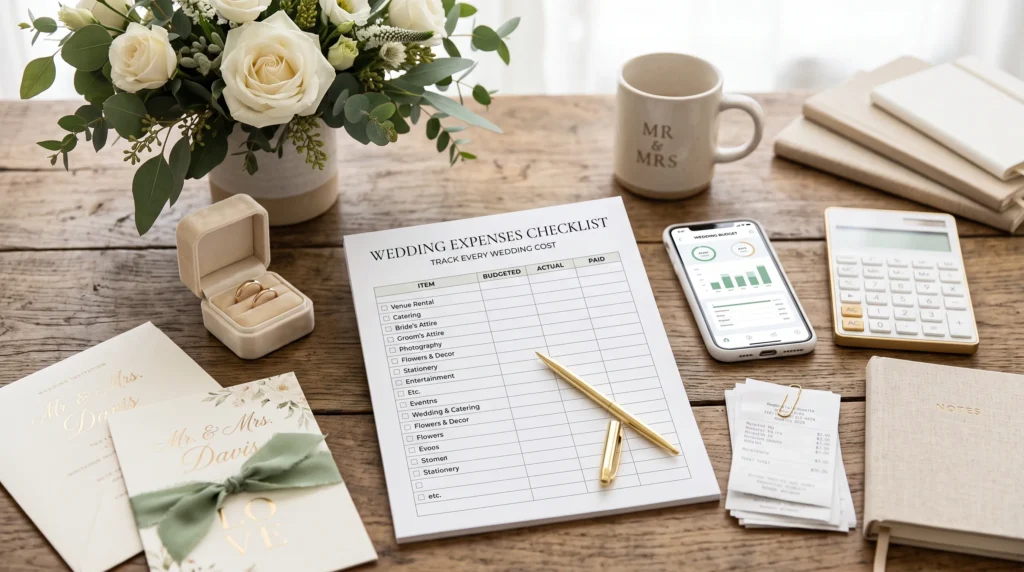
An estimate written once in a notes app isn’t a budget. A wedding budget is a living document, because quotes arrive over months and deposits go out long before final balances do.
Track six fields for every category:
| Field | Why it matters |
|---|---|
| Estimated cost | Your original allocation |
| Vendor quote | The real number, including tax and service charges |
| Deposit paid | What’s already committed |
| Remaining balance | What you still owe |
| Due date | Drives your monthly savings schedule |
| Actual final cost | What you truly spent, including overages |
The gap between estimated cost and vendor quote is where budgets quietly break. Review it monthly. When a category comes in over, decide immediately which category surrenders the difference — don’t let it silently drain the contingency fund.
Once vendor quotes start arriving, use our free expense tracking tool to keep wedding spending in one place, so deposits, balances, and due dates stop scattering across email threads and screenshots.
Use a Budget Calculator to Plan Your Wedding Savings
Your wedding budget doesn’t exist in isolation. It competes with rent, debt payments, retirement contributions, and whatever you’re saving toward next — often a home.
Before committing to a monthly savings figure, check it against your real monthly finances. Then run the arithmetic in both directions:
- Savings → budget: “I can save $700 a month for 14 months, so my wedding budget is X.”
- Budget → savings: “We want a $30,000 wedding in 18 months with $5,000 saved, so we need $1,389 a month — is that realistic?”
If the second number isn’t realistic, you have three honest options: spend less, extend the engagement, or shorten the guest list. Borrowing is a fourth, but it converts one day into years of interest payments.
How to Avoid Unexpected Wedding Expenses

These are the costs that blow past contingency funds:
- Sales tax on catering, rentals, and attire
- Service charges — often 18–25% on catering, and not the same as a tip
- Delivery, setup, and breakdown fees for rentals, flowers, and cake
- Overtime for venue, photographer, band, or bar past the contracted end time
- Vendor meals — most contracts require you to feed the team
- Alterations, which can reach several hundred dollars on a single dress
- Plus-ones and late RSVPs arriving after you’ve locked the catering count
- Extra hair and makeup hours for a large wedding party
- Cake cutting and corkage fees
- Guest transportation and parking
- Tips and gratuities across a dozen vendors
- Last-minute purchases in the final fortnight, which add up fast
Questions to ask every vendor before signing
- Does this quote include tax and service charges?
- What exactly is included, hour by hour?
- What triggers overtime, and at what rate?
- Are delivery, setup, and breakdown included?
- Do you require vendor meals?
- What’s the deposit, and is any of it refundable?
- What’s the payment schedule and final balance date?
- What’s the cancellation and postponement policy?
- Is there a substitution clause if my assigned photographer or coordinator can’t attend?
- Are there fees for changes to the contract later?
Get every answer written into the contract itself, not left in an email.
Wedding Budget Example: $30,000 for 100 Guests
An illustrative budget for a 100-guest wedding with a $30,000 maximum. Planning figures, not market averages.
| Wedding Expense | Estimated Budget |
|---|---|
| Venue | $6,000 |
| Catering (100 guests × $85) | $8,500 |
| Photography | $3,200 |
| Entertainment | $1,600 |
| Attire | $2,200 |
| Flowers & Décor | $2,000 |
| Cake | $600 |
| Planner/Coordinator | $1,200 |
| Invitations | $500 |
| Transportation | $700 |
| Miscellaneous | $1,000 |
| Contingency | $2,500 |
| Total | $30,000 |
Venue and catering together take $14,500 — about 48% of the total — which reflects how wedding spending typically concentrates. Contingency sits at 8.3%.
This example is for planning purposes only. Your actual costs will differ based on location, vendors, guest count, date, and preferences. Use the structure, not the numbers.
A 12-Month Wedding Budget Timeline
| When | Budget action |
|---|---|
| 12 months out | Set maximum budget, confirm contributions, fix guest count |
| 10–11 months | Get venue and catering quotes; lock the two biggest line items |
| 8–9 months | Book photographer and entertainment; log all deposits |
| 6 months | Review actual quotes against estimates; reallocate where needed |
| 4 months | Attire, florals, stationery; confirm what’s excluded from each quote |
| 2–3 months | Final headcount forming; recalculate per-guest costs |
| 1 month | Confirm final balances, tips, and vendor meals; check overtime terms |
| Week of | Cash for gratuities; freeze all new spending |
Wedding Budget Checklist
☐ Set maximum wedding budget
☐ Confirm available savings
☐ Calculate monthly savings
☐ Confirm family contributions
☐ Set guest count
☐ Research venue prices
☐ Compare catering options
☐ Get photographer quotes
☐ Compare entertainment options
☐ Plan attire budget
☐ Plan flowers and décor
☐ Budget for invitations
☐ Budget for transportation
☐ Ask vendors about hidden fees
☐ Track deposits
☐ Track remaining balances
☐ Keep a contingency fund
☐ Review the budget every month
Frequently Asked Questions About How to Budget for a Wedding
How much should a wedding cost?
As much as you can cover from savings and confirmed contributions without taking on debt or pausing essential financial goals. Calculate your maximum from your own finances first, then design the wedding to fit it.
Build a Wedding Budget You Can Afford
Before booking your venue or wedding vendors, understand how much you can realistically spend. Use our budget calculator to organize your income, expenses, and available budget.
Calculate Your Budget →How much does a typical wedding cost?
In the U.S., The Knot’s 2026 Real Weddings Study of 10,474 couples married in 2025 reported an average of $34,200. That figure is U.S.-only and spans a huge range by state, guest count, and budget bracket — treat it as context, not a target. The Knot
How much would a wedding cost for 100 guests?
It depends far more on venue, location, and catering style than on the headcount alone. As an illustration, a 100-guest wedding with $85-per-head catering, a mid-range venue, a photographer, a DJ, and moderate florals can be planned around $30,000 — while the same list in a major metro with plated service and an open bar can exceed $50,000.
How much does it cost for a wedding planner?
Full-service planners usually charge a flat fee or a percentage of total wedding spend; partial planners and month-of coordinators cost progressively less. Rates vary widely by city, experience, and complexity, so collect three detailed written quotes and compare exactly what each covers.
What is the biggest wedding expense?
Venue and catering combined, almost always — together they commonly consume 40–50% of a budget. That’s why guest count and venue choice affect your total more than any other decision.
How can I plan a wedding on a budget?
Start with the structural levers: a shorter guest list, an off-season or non-Saturday date, and a venue whose package pricing works in your favor. Then trim variable costs like favors, printed stationery, and imported flowers, and rent rather than buy.
How much should I save each month for a wedding?
Subtract current savings and confirmed contributions from your target budget, then divide by the months remaining. If the result strains normal spending, lengthen the engagement or lower the target rather than covering the gap with credit.
How do you budget for a wedding with a short engagement?
With under a year, most of your budget has to come from money you already have, since there’s little time to accumulate more. Lead with guest count and date flexibility — a smaller off-peak wedding is far easier to fund in six months than a large peak-season one.
How can I keep track of wedding expenses?
Maintain one tracker with estimated cost, vendor quote, deposit paid, remaining balance, due date, and final cost for every category, updated whenever a quote or payment happens. Review it monthly so overages get reassigned deliberately instead of consuming your contingency fund.
Conclusion: How to Budget for a Wedding, in Seven Moves
Understanding how to budget for a wedding comes down to a repeatable process, not a magic number:
- Decide what you can realistically afford from savings, monthly contributions, and confirmed family support.
- Set your maximum budget and write it down.
- Estimate every wedding expense, including the ones hiding in fine print.
- Prioritize the two or three categories that genuinely matter and fund them properly.
- Track every payment, deposit, and outstanding balance.
- Leave room for the unexpected with a 5–10% contingency fund.
- Review the budget monthly and reallocate deliberately when a quote lands high.
Couples who learn how to budget for a wedding properly don’t have cheaper weddings — they have calmer ones, and they start married life without a balance to pay down.
Ready to build your own numbers? Run your monthly finances through our budget calculator to find a realistic savings rate, then organize every quote and deposit with our free expense tracking tool.