Savings Goal Calculator: Plan Your Financial Future with Our Free Tool
Table of Contents
Introduction
Did you know that 78% of Americans live paycheck to paycheck? Even more sobering: most people who set financial goals abandon them within the first month. The disconnect between wanting financial security and actually achieving it isn’t about willpower—it’s about having the right tools and strategy.
Here’s the harsh truth: vague savings goals don’t work. Saying “I want to save more money” is like saying “I want to get fit” without a specific plan. Your brain needs concrete targets, measurable progress, and visual reminders to stay motivated. This is where a savings goal calculator becomes your financial game-changer.
Without a clear roadmap, it’s easy to lose track of what you’re working toward. Bills pile up, unexpected expenses derail your plans, and suddenly another year passes without meaningful progress toward the financial freedom you deserve. But imagine knowing exactly how much to set aside each month to reach your dream—whether that’s a down payment on a home, a dream vacation, or a fully funded emergency fund.
A savings goal calculator transforms vague aspirations into actionable, achievable plans. By breaking down your financial dreams into manageable monthly contributions, you create momentum and accountability. This guide shows you how to harness this powerful tool to take control of your financial future, starting today.
Stop Guessing. Start Saving.
Our free Savings Goal Calculator helps you set realistic targets, track progress, and reach your financial goals faster.
Try Our Free Calculator Today →
“The psychology behind goal-setting is well-documented. Research from financial literacy resources from the Federal Reserve shows that structured planning increases financial success rates significantly.”
Why You Need a Savings Goal Calculator
Financial psychology research reveals something powerful: people who track their progress are 40-50% more likely to achieve their goals. That statistic alone should convince you that a goal calculator isn’t just nice to have—it’s essential.
Here’s why tracking matters. When you use a savings target calculator, you’re not just crunching numbers. You’re engaging a psychological principle called the “progress principle”—our brains release dopamine when we see measurable advancement. Every time you track a deposit toward your goal, your brain receives a small reward signal. This creates a positive feedback loop that keeps you motivated.
Visualization is the second game-changer. A money goal calculator shows you a visual representation of your progress—maybe a progress bar moving closer to 100%, or a chart showing your balance climbing toward your target. This visual reinforcement is far more powerful than simply knowing “I’ve saved $5,000 so far.” You can see how close you are, which strengthens your commitment.
The third benefit is accountability. When you input your goals into a calculator and see the monthly contribution required, you make a conscious commitment. You’re no longer hoping savings will happen—you’re deliberately allocating money. This shifts your mindset from passive to active.
Additionally, tracking reduces decision fatigue. Instead of constantly wondering “Did I save enough this month?” you have a clear answer. This mental clarity reduces stress and frees up mental energy for other important decisions. Research shows that people who remove guesswork from their finances report higher satisfaction levels and lower anxiety about money.
Finally, a reliable goal calculator helps you identify unrealistic targets early. Maybe you want $50,000 in a year, but the calculator shows you’d need to save $4,167 monthly—and that’s 60% of your income. Rather than failing later, you adjust your timeline or target amount upfront. This prevents disappointment and helps you set goals you can actually achieve.
How to Use a Savings Goal Calculator: Step-by-Step Guide

Using a savings goal calculator is straightforward, but understanding each step helps you maximize results. Let’s walk through the process so you can turn your financial dreams into reality.
Step 1: Define Your Target Amount
Start by being specific about how much you need. Don’t just say “I want to save more.” Instead, ask yourself: “Exactly how much do I need?”
For an emergency fund, financial experts recommend 3-6 months of living expenses. If your monthly expenses are $3,000, that’s $9,000–$18,000. For a vacation, you might want $4,500. For a home down payment, maybe $50,000. The more precise your target, the more accurate your money goal calculator will be.
Write down your target amount. This becomes the foundation for everything else.
Step 2: Set Your Timeline
When do you need this money? This is crucial because it determines how aggressively you need to save.
A 12-month timeline requires much larger monthly contributions than a 5-year timeline for the same goal. Be realistic here. Don’t set impossible deadlines that guarantee failure. Instead, choose a timeline that feels challenging but achievable.
Step 3: Calculate Monthly Contributions
This is where the savings goal calculator does the heavy lifting. Input your target amount and timeline, and it shows your required monthly savings. If you want $12,000 in 12 months, you need $1,000 monthly. If you want it in 24 months, you need $500 monthly.
Understanding your monthly contribution target is essential. Now you can honestly assess: Can I find $500 in my monthly budget? If yes, you’ve found your path forward. If no, you either adjust your timeline or target amount.
Step 4: Track Your Progress
Set up automatic deposits to your savings account for the calculated amount. Many banks allow you to schedule automatic transfers. Then, check your progress monthly using the calculator.
Watching your balance grow toward your goal is incredibly motivating. Some people check weekly, others monthly. Find your rhythm. The key is maintaining that connection between your daily habits and your larger financial vision.
Essential Features in a Savings Goal Calculator
Not all budget goal tools are created equal. The best ones share several key features that make tracking easier and more motivating.
Real-Time Progress Tracking
The best calculators show your progress instantly. Input your current balance, and watch the calculator instantly update your progress percentage and remaining amount. This real-time feedback creates that motivational boost we discussed earlier. You want a tool that makes progress visible and satisfying.
Flexible Goal Adjustment
Life changes. Income fluctuates. Emergencies happen. A quality savings goal calculator lets you adjust your target amount or timeline without losing all your data. Maybe you discover you can only save $300 monthly instead of $500? Adjust the timeline, and the calculator recalculates automatically.
Multiple Savings Goals
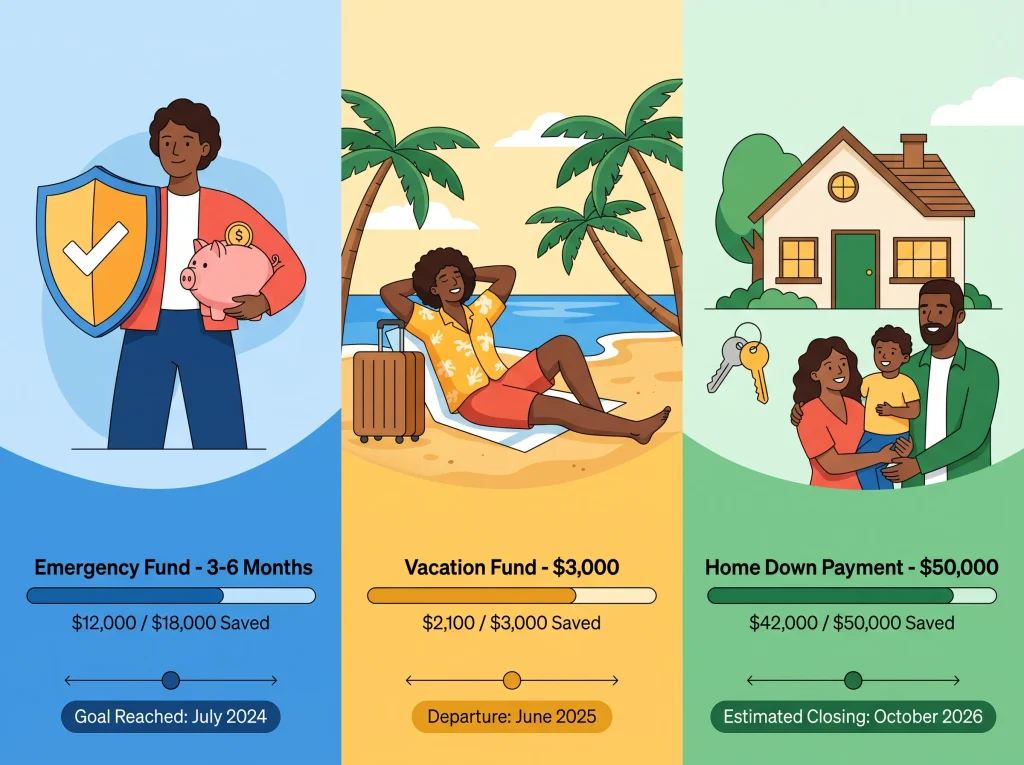
Most people have more than one financial goal. A robust goals savings tool lets you track separate targets—emergency fund, vacation, car purchase, home down payment—all at once. This prevents the common problem of abandoning one goal for another.
Interest Rate Calculations
If you’re saving in a high-yield savings account earning 4-5% annual interest, your goal calculator should account for this. Interest accelerates your progress, and including it in calculations provides a realistic timeline. Some calculators even let you factor in inflation for long-term goals.
Visual Progress Indicators
Charts, progress bars, and gauges transform abstract numbers into compelling visuals. When you see a progress bar move from 30% to 35%, you feel that progress viscerally. Visual indicators make your journey toward your goal feel real and tangible.
Savings Goal Calculator Examples
Let’s ground this in reality. Real-world scenarios show exactly how a savings goal calculator works and what’s possible.
Emergency Fund Goal
Meet Sarah. She has $15,000 in annual expenses and wants a 6-month emergency fund—$7,500 total. Using a goal calculator, she enters:
- Target: $7,500
- Timeline: 18 months
- Result: $417 monthly
Sarah adjusts her budget to set aside $417 each month into a high-yield savings account. In 18 months, she has her emergency safety net. This calculation would be tedious without a savings target calculator, but with it, she has her answer in seconds.
Vacation Fund Goal
James dreams of a $4,500 beach vacation next summer. He has 12 months to save. His money goal calculator shows:
- Target: $4,500
- Timeline: 12 months
- Result: $375 monthly
James realizes he can find $375 monthly by cutting streaming services and reducing dining out. The specific number makes the goal feel achievable. Without this clarity, he might procrastinate indefinitely.
Home Down Payment Goal
Maria wants to save $40,000 for a down payment over 48 months. Her savings goal calculation shows:
- Target: $40,000
- Timeline: 48 months (4 years)
- Result: $833 monthly
- Plus interest: (assuming 4.5% in a high-yield account adds roughly $3,600 bonus)
Maria realizes that if she saves $833 monthly, she’ll reach her goal slightly ahead of schedule due to interest earnings. This motivates her because she can see the finish line clearly. She can picture herself as a homeowner in four years.
Savings Goal Calculator vs. Other Budget Tools
Understanding how a savings goal calculator differs from other financial tools helps you choose the right solution for your needs.
| Tool | Primary Purpose | Best For | Limitations |
|---|---|---|---|
| Savings Goal Calculator | Set targets and track progress toward specific savings goals | Planning for future purchases, emergency funds, or major life events | Focuses on savings only; doesn’t track spending |
| Monthly Budget Calculator | Track all income and expenses to manage cash flow | Understanding where your money goes each month | Doesn’t project future savings or goals |
| Expense Tracker | Record and categorize daily spending | Finding areas to cut costs | Reactive rather than proactive |
| Mortgage Calculator | Calculate home loan payments and total interest | Understanding home-buying affordability | Specific to mortgages only |
A savings goal calculator is uniquely designed for goal-setting and motivation. While a monthly budget calculator shows you where money goes month-to-month, a savings goal calculator shows you where you’re going long-term. Ideally, you’d use both: the monthly budget to create the surplus, and the goal calculator to deploy that surplus toward your dreams.
Think of it this way: your budget calculator is your dashboard. Your money goal calculator is your GPS. Both are essential for reaching your destination.
Stop Guessing. Start Saving.
Our free Savings Goal Calculator helps you set realistic targets, track progress, and reach your financial goals faster.
Try Our Free Calculator Today →Pro Tips to Maximize Your Savings Goals
Now that you understand how to use a savings goal calculator, here are advanced strategies to accelerate your progress.
Automate Your Savings
The single most effective strategy is automation. Set up automatic transfers from your checking account to your savings account on payday—before you have a chance to spend the money. Your employer might even let you split your direct deposit. This “pay yourself first” approach removes temptation and ensures you hit your monthly targets consistently.
Automated savings follows a principle called “out of sight, out of mind.” When you don’t see money in your checking account, you’re less likely to spend it. Over months and years, this psychological trick compounds into serious wealth.
Break Large Goals Into Milestones
A $40,000 goal feels overwhelming. But breaking it into 4 milestones of $10,000 each makes it manageable. Celebrate when you hit $10,000, then $20,000, then $30,000. Each milestone provides a psychological win and renewed motivation.
Your savings target calculator can help here. Adjust the timeline periodically to celebrate micro-victories. These wins matter—they keep you engaged.
Review and Adjust Regularly
Life changes quarterly, not yearly. Set a reminder to review your goals savings progress every three months. Ask yourself: Am I on track? Has my income changed? Have my priorities shifted? This regular check-in prevents drift and keeps your goals aligned with your reality.
Account for Unexpected Expenses
Most people’s budgets fail because they don’t account for surprises. Your car breaks down. Your roof needs repair. Your medical expenses spike. Build a small buffer into your savings plan.
If your goal calculator shows you need $500 monthly, challenge yourself to save $525 or $550. That extra $25-50 creates a buffer that prevents setbacks from derailing your entire plan. Small buffers prevent plan abandonment.
“Sarah’s approach aligns with best practices outlined in emergency fund savings strategies, which recommend maintaining 3-6 months of living expenses as your safety net.”
Frequently Asked Questions
What’s the difference between a savings goal calculator and a budget calculator?
A savings goal calculator focuses on specific targets and timelines—how much you need to save monthly to reach $10,000 in 18 months. A budget calculator tracks overall income and expenses. Use both for complete financial management.
Can I have multiple savings goals at once?
Absolutely. The best money goal calculators let you track multiple goals simultaneously. Maybe you’re saving for an emergency fund and a vacation at the same time. Divide your surplus between goals based on priorities.
How often should I update my savings goal calculator?
Check your progress monthly and do a comprehensive review quarterly. If your income or expenses change significantly, update your calculator immediately. Adjusting to reality keeps your plan achievable.
What if I can’t hit my monthly savings target?
Adjust your timeline. If you planned to save $500 monthly but can only manage $300, extend your timeline by 67%. It’s better to extend the timeline and succeed than stick to an impossible target and fail.
Should I include interest in my savings goal calculations?
Yes, if you’re earning meaningful interest (4%+ annually). However, for safety, calculate conservatively and treat interest as a bonus that accelerates your progress.
Is a savings goal calculator appropriate for beginners?
Definitely. Beginners especially benefit from clarity. A goal calculator removes guesswork and provides concrete next steps, making it perfect for anyone starting their financial journey.
Can I use a savings goal calculator for debt payoff?
Yes. The same principles apply. Set your debt payoff amount as your target and timeline. Your calculator shows the required monthly payment, helping you stay on track.
What if my savings goal changes?
Update your calculator and adjust accordingly. Your goals should evolve with your life. The flexibility of using a savings target calculator is one of its greatest strengths.
How do I stay motivated between milestones?
Celebrate small wins, visualize your progress regularly, and remind yourself why you’re saving. Many people post their goal on their fridge or set phone reminders of their target. Visibility keeps motivation high.
Is compound interest factored into most calculators?
Quality savings goal calculators offer interest calculations. Always check the tool’s specifications. If interest is included, your goal becomes easier to achieve than calculated.
Stop Guessing. Start Saving.
Our free Savings Goal Calculator helps you set realistic targets, track progress, and reach your financial goals faster.
Try Our Free Calculator Today →Conclusion
Financial success isn’t about luck—it’s about having a plan and tracking progress. A savings goal calculator gives you both. By transforming vague dreams into specific targets and concrete monthly contributions, you shift from hoping to achieving.
The statistics don’t lie: people who use goal-tracking tools achieve their objectives 40-50% more often than those who don’t. You don’t need to be naturally disciplined or earn a six-figure income. You need clarity, a system, and the discipline to follow it.
Start today. Identify one savings goal—whether it’s an emergency fund, vacation, or down payment. Input it into a goal calculator. See your monthly target. Set up automatic transfers. Track your progress monthly. Within months, you’ll see real movement. Within a year or two, you’ll achieve what once seemed impossible.
The gap between where you are now and where you want to be isn’t as wide as it feels. It just requires a savings goal calculator, a plan, and consistent action. Your financial freedom is waiting—are you ready to claim it?
Try our free savings goal calculator today and take the first step toward the financial future you deserve.